 Arboris Botanical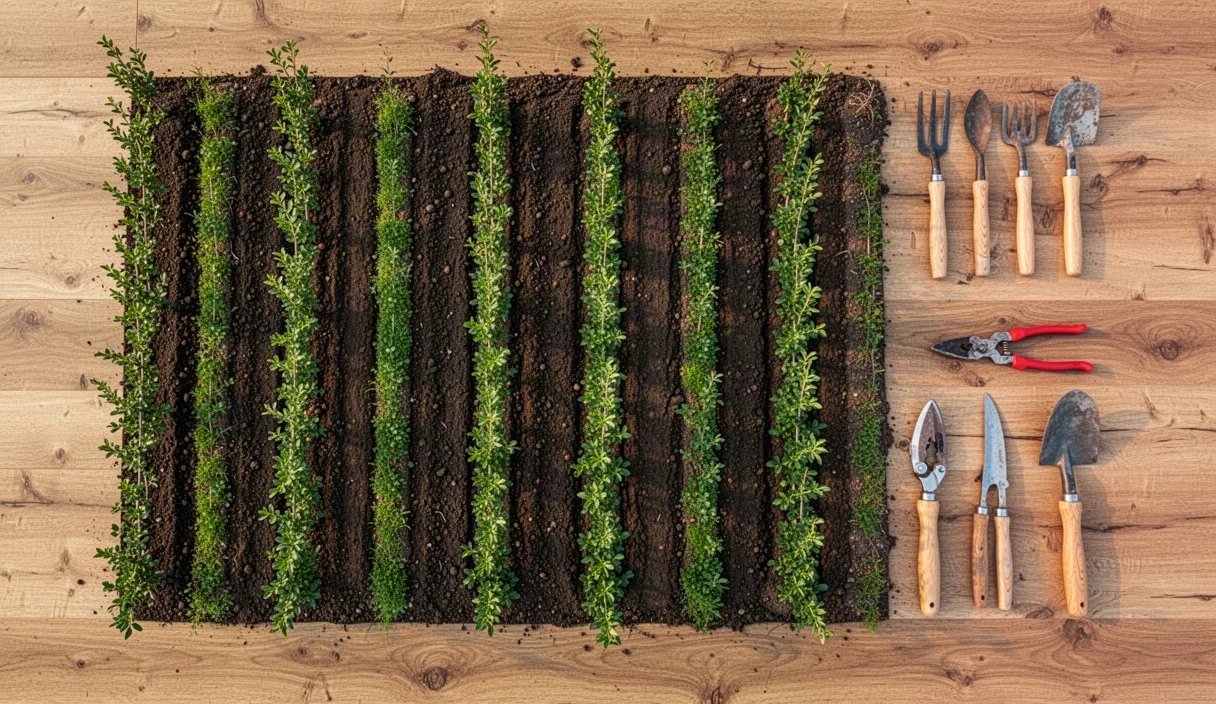
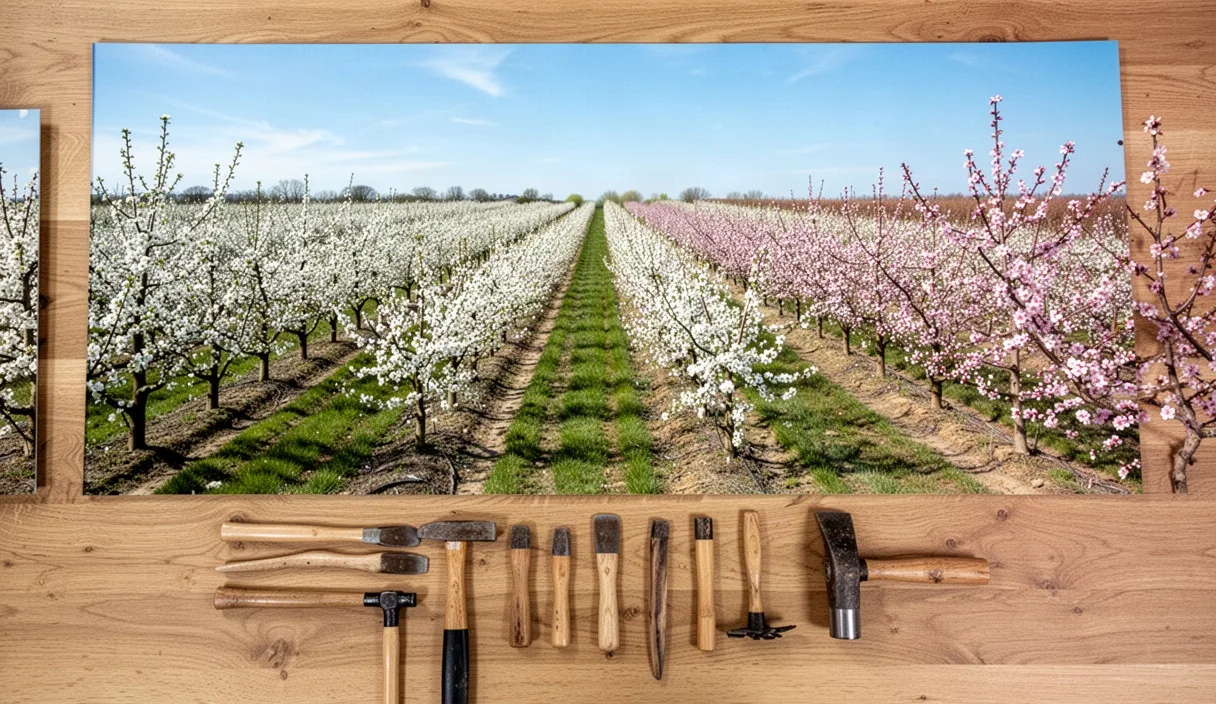
Tractor clearance dictates row spacing. Get this calculation wrong during block layout, and the orchard will suffer skinning bark, snapped branches, compacted rooting zones, and ruined equipment for thirty years. Modern commercial operations cannot rely on generic nursery recommendations. Spacing requires balancing rootstock vigor, soil fertility, canopy training systems, and the physical sweep path of your widest implements under full load.
Every mechanical pass compacts the soil. Ripping out damaged trees or retrofitting an undersized headland after planting costs thousands of dollars per hectare in lost production and wasted labor. Establish exact machinery dimensions, implement draft sweeps, and root protection envelopes on paper before ordering saplings or driving surveyor pegs into the subsoil.
Tractor wheel track measurements against tree dripline projections
Measure implements at their absolute widest protrusions, not the manufacturer wheel track specifications. An orchard tractor rated at 1.4 meters outside tire width often measures 1.7 meters once mirrors, exhaust stacks, operator guards, and wide-profile flotation tires are mounted. Trailed equipment presents an even wider footprint. A 2000-liter airblast sprayer with high-volume volute towers or side deflectors frequently spans 1.85 meters to 2.15 meters across the housing.
Tree canopies do not stay within tidy vertical walls. Even on rigorous trellis systems such as central leader spindles or V-trellis systems, mature branches sag under heavy fruit loads. A high-density apple canopy on M.9 rootstocks pruned to an 80-centimeter cross-sectional depth in year two will expand to 1.2 meters at full cropping capacity in year five. Stone fruit on semi-vigorous rootstocks such as Lovell or Krymsk 86 can spread 2.2 meters across the middle if summer pruning is delayed by adverse weather.
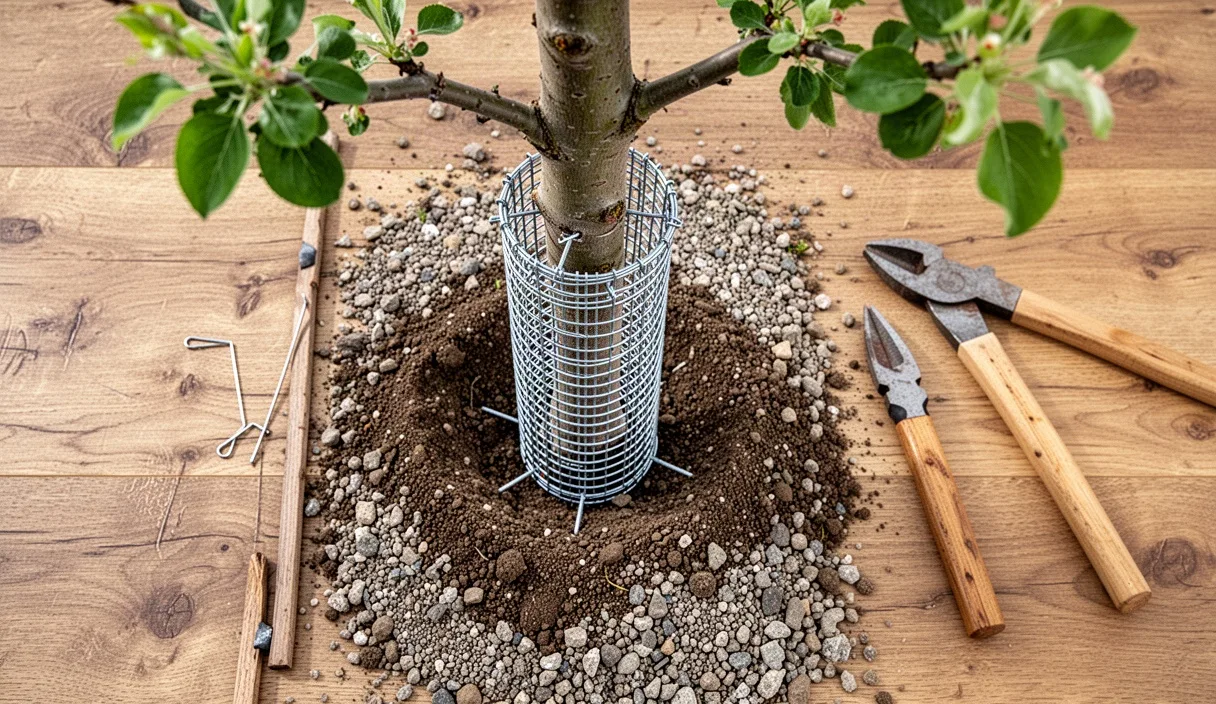
The machinery travel corridor must account for the root dripline as well as the above-ground limbs. Feeder roots reside predominantly in the top 45 centimeters of soil and extend 30 to 60 centimeters past the outer edge of the leaf canopy. Driving heavy tractors directly over this zone causes severe subsoil compaction, poor water infiltration, and root shearing. Maintain a minimum operating clearance of 60 centimeters between the outermost edge of tractor tires and the projected dripline of the mature canopy.
| Machinery Combination | Equipment Operating Width | Mature Canopy Spread | Minimum Inter-Row Spacing |
|---|---|---|---|
| Narrow tractor (1.4m) + Bin trailer (1.7m) | 1.70 meters | 0.90 meters | 3.20 meters |
| Standard orchard cab (1.65m) + Trailed sprayer (1.95m) | 1.95 meters | 1.20 meters | 3.65 meters |
| Utility tractor (1.9m) + Flail mower (2.1m) | 2.10 meters | 1.50 meters | 4.10 meters |
| Platform harvester (2.2m operating profile) | 2.20 meters | 1.10 meters | 3.80 meters |
| Standard utility tractor (2.0m) + Broadacre subsoiler (2.4m) | 2.40 meters | 1.80 meters | 4.80 meters |
Calculate your clear working alleyway width using this baseline formula:
- Clear Alleyway = (Widest Implement Width) + (2 x Tire Lateral Drift Allowance) + (2 x Canopy Buffer)
- Allow 20 centimeters for tire drift on flat terrain, or 35 centimeters on rolling topography.
- Allow 45 centimeters minimum canopy buffer for formal trellised systems, or 75 centimeters for free-standing vase canopies.
Headland turnaround engineering for hitched sprayers
Hitched implements dictate headland geometry. A trailed airblast sprayer acts as a tracking unit that cuts inside the path of the tractor during a turn. If the headland is too narrow, the tractor operator must execute three-point turns with a live power take-off (PTO) shaft. Cycling a PTO shaft past a 70-degree angle under load accelerates universal joint wear, damages slip clutches, and shears implement yokes.
Calculate turning radius using the combined wheelbase, the tongue hitch-to-axle dimension, and the maximum steering lock of the front wheels. A standard 75-horsepower orchard tractor pulling a tandem-axle 2000-liter sprayer requires a minimum turning diameter of 15.5 meters to make a smooth, continuous 180-degree turn from one row directly into an adjacent row. Without this turning space, the operator must skip rows, turning into the fourth or fifth row over using a teardrop or lightbulb maneuver.
Headland widths should match equipment needs rather than arbitrary plot lines:
- Direct-entry headlands for continuous turns require a clear perimeter of 9.0 meters to 11.0 meters from the row-end anchor posts to the boundary fence or tree line.
- Skip-row turnaround systems require a minimum perimeter of 7.5 meters, provided tractor operators are trained on precise entry patterns that prevent tire scuffing on the outside anchor wires.
- Narrow headlands below 6.5 meters force operators to reverse equipment with hitched trailers, which leads to damaged row ends, irrigation risers snapped off at ground level, and bent end-post assemblies.
Headland surfacing demands gravel or heavy grass reinforcement. Continuous turning of 4-metric-ton machinery combinations will churn bare ground into deep ruts during wet early-spring pest sprays. These ruts alter sprayer boom height, shake calibrate-critical nozzle alignments, and transfer structural shock through the tractor chassis.
Row orientation rules for sunlight balance
Sunlight distribution governs fruit finish, bud differentiation, and pesticide drying rates. Orient rows strictly north-south wherever terrain allows. A north-south orientation exposes both sides of the canopy to equal amounts of daily solar radiation, catching morning sun on the eastern face and afternoon sun on the western face.
North-south alignments ensure that tree shadows fall into the alleyway during midday rather than covering adjacent trees. Calculate row height-to-width ratios carefully to avoid self-shading. The height of the mature tree canopy should never exceed 1.2 times the clear alleyway width between tree foliage. For example, if your open space between foliage lines is 2.5 meters, limit mature tree height to 3.0 meters. Canopies exceeding this ratio cast deep shadows across the lower 40 centimeters of adjacent canopies, causing bare wood, poor fruit set, and increased fungal susceptibility.
Deviate from north-south row lines under two specific conditions:
- Prevailing crosswinds exceed 25 kilometers per hour on a regular basis. In high-wind corridors, orient rows within 30 degrees of the prevailing wind direction to minimize sprayer drift deflection, reduce trellised crop lodging, and avoid structural trellis failure.
- Topographic contours dictate side-hill travel. Running machinery across steep slopes risks equipment rollover. When slope exceeds critical stability limits, adjust row orientation to follow the natural contour or run directly along the fall line if erosion control allows.
Slope thresholds for side-hill machinery stability
Liquid payloads change operating physics on hillsides. A trailed sprayer carrying 2000 liters of water shifts its center of gravity dynamically as fluid sloshes across internal compartments. A slope that is completely manageable with an empty bin trailer becomes hazardous with a full spray tank. Baffled tanks reduce this surge, but they do not eliminate downhill gravitational mass transfer.
Observe these slope limits when establishing machinery travel directions:
- Zero to 7 degrees (up to 12% slope): Safe for all standard orchard utility equipment, wide mowers, and single-axle trailed loads. Standard four-wheel-drive tractors operate with minimal lateral slide.
- 8 to 14 degrees (14% to 25% slope): Maximum safe threshold for cross-slope operation with specialized low-clearance, wide-track orchard tractors. Sprayer tanks must have full internal baffling. Reduce travel speed below 5 kilometers per hour to prevent mechanical bounce from tripping a rollover. Trailed equipment must feature wide-track axles set to at least 1.8 meters.
- 15 degrees and above (greater than 27% slope): Do not run machinery across the slope. Switch block layouts to run straight up and down the fall line, provided that soil management programs, cover crops, and gravel access lanes prevent catastrophic gully erosion. Above 18 degrees, standard wheeled tractors lose traction during uphill return passes; this work requires tracked crawlers or specialized winch systems.
Machinery stability models assume firm ground. Saturated topsoil, loose shale, or damp clover groundcovers cut rollover stability margins by a third. Consult an agricultural mechanical engineer before plotting rows across slopes steeper than 10 degrees.
Marking boundary offsets before running the subsoiler
Deep ripping shatters hardpan layers and provides a non-compacted rooting zone for tree establishment. Subsoilers operate at working depths of 60 to 90 centimeters, generating massive lateral drag and underground soil displacement. If the operator pulls a subsoiler shank too close to boundary lines, buried utility corridors, or drainage infrastructure, the subsurface disruption can shear pipes, rip down perimeter fences, or compromise roadbeds.
Complete your layout staking and run subsoilers before finalizing row end posts, overhead wire systems, or permanent irrigation mains. Once high-tensile trellis anchors are driven, deep tillage tools cannot work within 3 meters of the row ends without hooking structural anchor plates.
Execute your site offset workflow in this sequence:
- Locate and confirm official property boundary markers using optical transits or an RTK-GPS surveying rover.
- Notify utility locators to flag buried power lines, fiber-optic routes, and pressurized water mains.
- Stake an absolute subsoiler exclusion zone 4.0 meters away from property fences and 5.0 meters away from established drainage swales or ditch banks to prevent bank cave-ins.
- Set an offset line 2.5 meters away from mature windbreak root lines. Subsoiler shanks will rip heavy roots from adjacent timber, dulling tooling and killing windbreak protection.
- Establish headland turnaround boundaries, leaving room for the subsoiler tractor to drop and lift its shanks completely clear of future end-post anchors. Subsoilers must reach full operating depth before crossing the first tree station in every row.
Common mistakes
Operators frequently base clearance calculations on factory catalog footprints. A tractor chassis might span 1.5 meters, but the spray boom valves, safety steps, limb lifters, and side mirrors push that footprint outward. Always run the actual working machinery through measuring calipers before marking rows.
Growers often shortchange headland space to squeeze in three more trees per row. Gaining thirty trees across a five-hectare block does not justify the loss of equipment efficiency. Tight headlands guarantee destroyed anchor posts, torn-off sprayer nozzles, crushed end trees, and compacted soil that inhibits water drainage at the primary access gates.
Failing to plan for vertical canopy sag under heavy crop loads remains a chronic error. A sweet cherry orchard or heavy-bearing apple block might provide 1.2 meters of open alleyway clearance in May, but by July, fruit-laden lateral branches drop into the travel lane. If tractor roll bars, mirror assemblies, or bin trailers brush these limbs, fruit drops prematurely, commercial value degrades through skin punctures, and pathogens enter torn bark tissue.
Practical next steps
Assemble your machinery catalog immediately. Measure the exact length, width, hitch height, and turning limit of every tractor, mower, shredder, sprayer, and harvesting aid on the farm. If acquiring new machinery over the next three seasons, obtain precise mechanical drawings from the equipment dealership prior to breaking ground.
Stake the block using high-accuracy RTK-GPS equipment. Avoid pulling standard tape measures across long, uneven terrain; cumulative slope error can throw inter-row spacing off by 30 to 50 centimeters over a 200-meter row span. Place brightly painted survey hubs at all four corners of each proposed block and mark the exact headland cut-off lines.
Conduct a physical drive-through test on the bare field. Run the tractor and trailed sprayer through the proposed row entrances and complete full turning maneuvers on the raw headlands before running subsoilers, planting windbreaks, or boring trellis post holes. Verify physical ground clearance with your own eyes while implements are hitched and operating.