 Arboris Botanical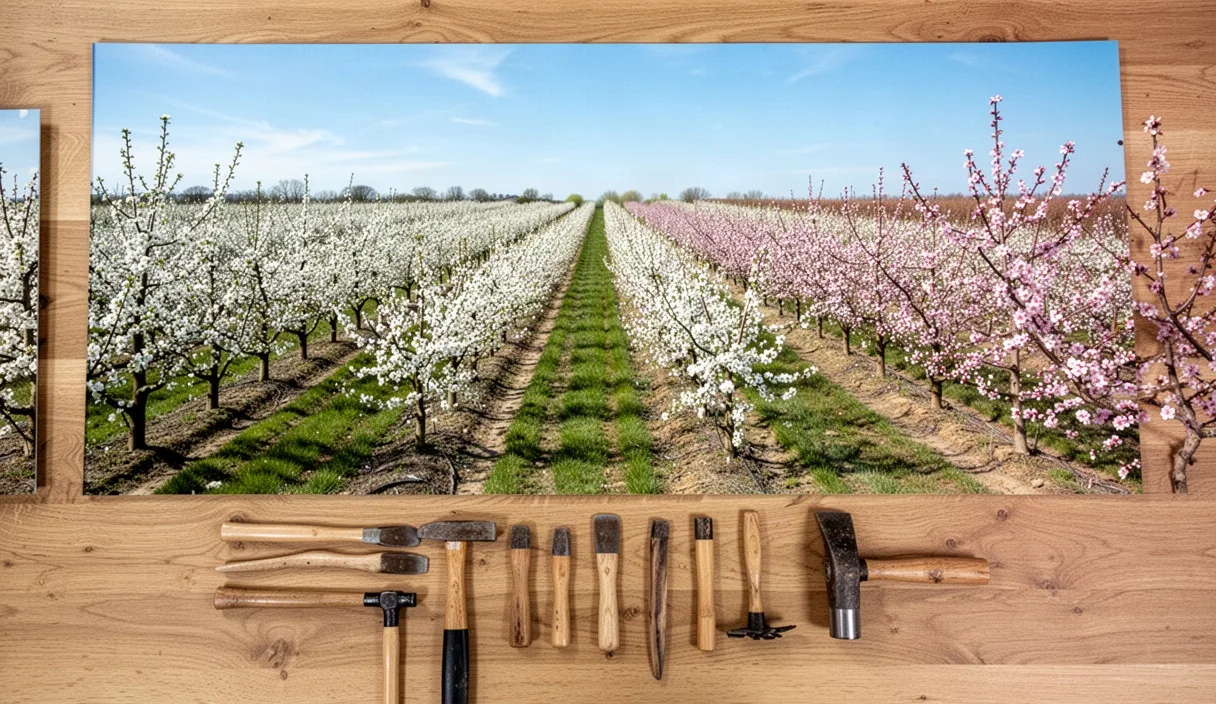
Commercial apple blocks require compatible, viable pollen delivered during king bloom. Modern high-density orchards planted on dwarfing rootstocks maximize light interception and labor efficiency, but monoculture rows isolate scion varieties from needed cross-pollination. Relying on perimeter hedgerows or wild crabapples does not work in a block planted at 1,200 to 2,000 trees per acre. Orchardists must engineer pollen distribution directly into the row grid to achieve uniform fruit set across the canopy.
Every commercial cultivar features specific genetic self-incompatibility mechanisms controlled by multi-allelic S-RNase genes. Two cultivars sharing identical S-alleles cannot pollinate each other. Interplanting requires matching compatible alleles, synchronizing flowering dates under fluctuating spring thermal units, and placing pollen donors within the restricted foraging lanes of commercial bees. Systematic planting plans convert these biological bottlenecks into predictable seasonal yields.
Bloom period charting: early, mid, and late flowering windows
Cross-pollination succeeds only when viable pollen transfers while the king bloom ovule remains receptive. The receptive window of the primary flower lasts between 48 and 72 hours, depending on spring temperatures and desiccation rates. Charting local bloom phenology over a rolling five-year baseline prevents expensive planting errors caused by year-to-year shifts in growing degree day (GDD) accumulation.
Orchards track phenology using base 43 degrees Fahrenheit. Early cultivars such as Idared and McIntosh reach green tip and tight cluster rapidly, while Rome and Golden Delicious break dormancy much later. When designing a block, pair the main commercial scion with at least two pollinizer varieties: one that begins flowering three days before the target tree's king bloom, and one that peaks during petal fall of the king bloom to cover side blooms if frost destroys the primary flower.
| Flowering Window | Commercial Cultivars | Compatible Crabapple Pollinizers | Base 43F GDD Accumulation |
|---|---|---|---|
| Early Season | Idared, McIntosh, Zestar, Premier Honeycrisp | Manchurian, Mount Arbor, Dolgo | 210 to 260 GDD |
| Mid Season | Gala, Honeycrisp, Fuji, Ambrosia | Snowdrift, Indian Summer, Evereste | 270 to 340 GDD |
| Late Season | Granny Smith, Cripps Pink, Rome, Scilate (Envy) | Golden Gem, Frettingham, Professor Sprenger | 350 to 420 GDD |
Triploid cultivars, including Jonagold, Mutsu, and Stayman, produce sterile pollen. When planting triploid blocks, interplanting schemes must incorporate two distinct, mutually compatible diploid pollen donors. If an orchardist interplants only one diploid pollinizer with a triploid scion, the pollinizer tree receives no viable pollen return, reducing its own cropping load and leading to irregular alternate-bearing patterns that unbalance row management.
Confirm the S-allele profile before purchasing nursery stock. For example, Honeycrisp carries alleles S2 and S9, while Gala carries S2 and S5. Because they share the S2 allele, cross-pollination between these two is semi-compatible, yielding lower pollen tube kinetics than a fully compatible cross like Honeycrisp (S2S9) and Granny Smith (S3S23). Deploying wild-derived crabapples (Malus species) bypasses many cultivated S-allele overlaps because their allelic profiles differ substantially from domesticated scions.
Bee foraging behavior: inter-row versus down-the-row flight paths
Honeybees conserve energy by working linear paths. In tight-density tall spindle and V-trellis systems, an individual honeybee (Apis mellifera) flies down the same side of the tree row for 84 percent to 91 percent of its individual foraging trip. Bees rarely cross the 10-foot to 12-foot herbicide and grass drive alleys between rows unless the floral resource down the row is completely depleted.
Inter-row switching drops dramatically when high winds exceed 12 miles per hour or when wire-trained canopies create continuous vegetative walls. This linear flight behavior means commercial trees planted three rows away from a pollinizer receive significantly fewer pollen deposits than trees in the direct row. If a pollinizer is placed in an adjacent row rather than in-row, pollination transfer relies on the small fraction of flights that break the row axis, combined with in-hive pollen transfer among nestmates rubbing against each other inside the brood chambers.
- Down-the-row travel: Bees move between two and four trees per foraging minute, inspecting only four to six open blossoms per tree before stepping forward.
- Row-jumping triggers: Floral densities falling below 15 open blooms per linear foot of canopy induce search behaviors that push bees across alleys.
- Canopy layer fidelity: Individual foragers show strong loyalty to specific vertical zones, working either the lower canopy tier (2 to 5 feet) or the upper wire (6 to 10 feet) during a single collection run.
Alternative pollinators show distinct flight mechanics that offset honeybee limitations. Blue orchard bees (Osmia lignaria) and hornfaced bees (Osmia cornifrons) forage under cooler, cloudier conditions starting at 54 degrees Fahrenheit, compared to honeybees that require 60 degrees Fahrenheit for high activity. Osmia species make short, haphazard flights, crossing between tree rows 32 percent more frequently than commercial honeybees. Integrating native bees or managed mason bee shelters along perimeter blocks improves lateral pollen transfer across the alleyways.
Crabapple pollinizer ratios for tight-density trellis systems
High-density trellis spacing requires deliberate placement ratios. The historic standard of placing one pollinizer every tenth tree in every tenth row produces severe crop distribution gradients in dwarf orchards. In a spindle planting with trees spaced 3 feet apart in the row and 11 feet between rows, that historic pattern leaves commercial trees more than 30 feet from the nearest pollen source, far beyond the down-the-row focus of a typical bee run.
Modern tall spindle designs use a ratio of 1:7 or 1:8 within the row, ensuring that no commercial tree sits more than four spaces from a compatible pollen source. Stagger the pollinizers across adjacent rows to avoid creating dead zones. Staggering produces an offset diagonal matrix across the orchard floor, giving both down-the-row foragers and row-crossing foragers frequent contact with viable pollen.
| Planting Density (Trees/Acre) | In-Row Spacing | Target Ratio | Pollinizer Frequency | Design Pattern |
|---|---|---|---|---|
| 900 to 1,150 | 4.0 feet | 1:8 | Every 9th position | Diamond offset across rows |
| 1,200 to 1,500 | 3.5 feet | 1:7 | Every 8th position | Checkerboard diagonal |
| 1,600 to 2,200 | 2.5 to 3.0 feet | 1:6 | Every 7th position | Staggered zigzag pattern |
Growers use three physical integration methods for crabapples in tight plantings. The first is dedicated tree placement, where the crabapple occupies its own standard space on the wire. This approach offers easy rootstock management but replaces a profit-generating commercial scion. In an orchard of 1,400 trees per acre at a 1:7 ratio, dedicated trees consume 175 canopy spaces per acre, reducing primary yield volume.
The second option is the pollinizer insert, planted directly between two commercial trees on the same wire, cutting the in-row space to 1.5 feet at that station. This maintains full commercial tree density but requires strict root competition control. The third option is top-grafting or limb-grafting pollinizers into the upper canopy of existing trees at the 7-foot wire mark. Limb grafts do not use floor space, but workers can accidentally prune them out during winter dormant pruning unless they are tagged with bright, permanent wire bands.
Managing pollen variety growth habits to match commercial tree size
Crabapple cultivars show extreme differences in vegetative vigor compared to domestic scions. Varieties like Manchurian grow aggressively, sending out water sprouts that shade adjacent fruiting wood if left unchecked. If Manchurian is grafted onto a vigorous rootstock such as M.7 or even a standard Malling-Merton clone, it will outgrow a commercial scion planted on dwarfing Malling 9 (M.9) or Geneva 41 (G.41) within three seasons.
Match the rootstock of the pollinizer directly to the vigour of the surrounding commercial block. If the block runs on G.11, put the crabapples on G.11 or Budagovsky 9 (B.9). B.9 is exceptionally useful as a pollinizer rootstock because its natural dwarfing and early shutdown suppress invasive canopy growth, keeping the pollinizer within a 24-inch cylinder without extensive manual intervention.
Follow a strict post-bloom pruning regime to keep pollinizers confined and flowering reliably each spring:
- Conduct pruning immediately at petal fall: Never prune crabapple pollinizers during the winter dormant season. Dormant pruning cuts away the floral buds formed the previous summer, eliminating the pollen crop for the coming spring.
- Hedging back to renewal stubs: Cut lateral shoots back to 2-inch to 4-inch stubs within seven days after blossom petal fall. This timing forces vegetative renewal growth during June that forms new fruit buds by August for next season.
- Strip pollinizer fruitlets: Crabapples that retain heavy fruit loads turn biennial, producing zero flowers every second year. Apply targeted post-bloom chemical thinning sprays or hand-strip pollinizer fruit before July 1 to safeguard flower bud initiation.
- Apply prohexadione-calcium: Spray shoot tips with prohexadione-calcium at a concentration of 125 to 250 parts per million when terminal growth reaches 2 inches. This suppresses vegetative extension, reduces fire blight susceptibility, and retains the columnar form required by narrow trellis rows.
Disease susceptibility represents a major operational risk. Manchurian crabapple carries latent apple stem grooving virus and shows high vulnerability to fire blight (Erwinia amylovora). A single blighted crabapple serves as an infection hub, spreading bacteria down the high-tensile trellis wire during late-spring rain events. Evereste and Indian Summer show superior field tolerance to fire blight and apple scab compared to older wild selections. Inspect all pollinizer stations weekly during bloom for shoot blight symptoms, and prune infected limbs 12 inches below visible discoloration using sanitized shears.
Tracking fruit set percentages across the block after petal drop
Accurate fruit set evaluation informs chemical thinning programs and highlights spatial pollination failures before fruit sizes up. Begin tracking seven to ten days after petal fall, when unfertilized king flowers turn yellow and abscise from the spur. Relying on visual impressions from the tractor cab yields inaccurate assessments that can lead to costly over-thinning or under-thinning.
Set up a permanent sampling grid during the pink bud stage. Flag 20 representative commercial trees per five-acre management unit. On each sample tree, flag five two-year-old limbs located across the lower, middle, and upper canopy tiers. Count and record the exact number of blossom clusters on every flagged limb before the flowers open.
Return to the flagged limbs approximately 14 to 21 days after petal drop, after the natural early wave of unfertilized fruitlet drop finishes. Count the remaining active, green fruitlets. Calculate fruit set efficiency using the standard commercial formula:
Fruit Set Percentage = (Total Surviving Fruitlets / Total Initial Blossom Clusters) * 100
Interpret the resulting percentages based on the commercial variety and target pack-out fruit size:
- Honeycrisp: Requires a target of 55 to 70 surviving fruitlets per 100 blossom clusters. Higher sets induce biennial bearing and reduce return bloom to near-zero levels the following year.
- Gala and Fuji: Require 110 to 140 surviving fruitlets per 100 clusters prior to chemical thinning, as these varieties set multiples per spur and require multi-stage thinning to achieve single-fruit spacing.
- Processing varieties: Target 150 to 180 fruitlets per 100 blossom clusters to maximize total tonnage rather than individual piece size.
Map the spatial set pattern across the block. If flagged trees located three or four spaces away from the nearest pollinizer show fruit set drops of 35 percent or more relative to trees adjacent to the pollinizer, your row design suffers from pollen exhaustion. This data informs corrective action, indicating where to graft supplementary limbs or position bumblebee (Bombus impatiens) quads the following spring to improve pollen distribution across the rows.
Common mistakes
- Relying on a single pollinizer cultivar: Planting only one crabapple variety leaves the block unprotected if that variety blooms early due to unusual heat units, missing late commercial king blooms entirely.
- Pruning crabapples in the winter: Dormant pruning removes the next season's floral wood. Pollinizers pruned in February will produce vigorous water sprouts and zero flowers in May.
- Mismatched rootstocks: Putting a vigorous crabapple on an M.7 or standard rootstock inside a high-density M.9 block leads to light starvation for adjacent commercial trees.
- Allowing biennial cycling: Failing to strip tiny fruitlets from crabapples allows them to enter alternate-year bearing, cutting your cross-pollination resources in half every other year.
- Ignoring virus transmission: Top-grafting untested crabapple scions onto clean commercial stock can transfer latent viruses, causing sudden tree decline or graft union failure.
Practical next steps for implementation
Execute these immediate actions to establish or rehabilitate pollen distribution in your blocks:
First, pull historical bloom records for your commercial scion varieties and chart the exact date ranges of early pink, king bloom, and petal fall over the past three seasons. Identify the local calendar window where king bloom ovule receptivity peaked.
Second, cross-reference your commercial varieties with the USDA S-allele register to ensure that planned pollinizers provide full genetic compatibility. Select a minimum of two pollinizer varieties that bracket the commercial bloom window.
Third, walk existing blocks during petal fall to audit pollinizer ratios. Measure the exact physical distance between pollen sources down every row. Mark all gaps wider than eight tree stations for supplemental interplanting or spring top-grafting.
Fourth, order certified, virus-indexed nursery stock on dwarfing rootstocks matching the vigor of your target block. If inserting pollinators between established trees, order whip stock on B.9 or G.11 rootstocks to prevent excessive root competition with producing trees.
Finally, consult a certified commercial orchardist or regional extension pomology specialist to verify chemical thinning compatibility and regional chill-hour requirements before finalizing tree orders.