 Arboris Botanical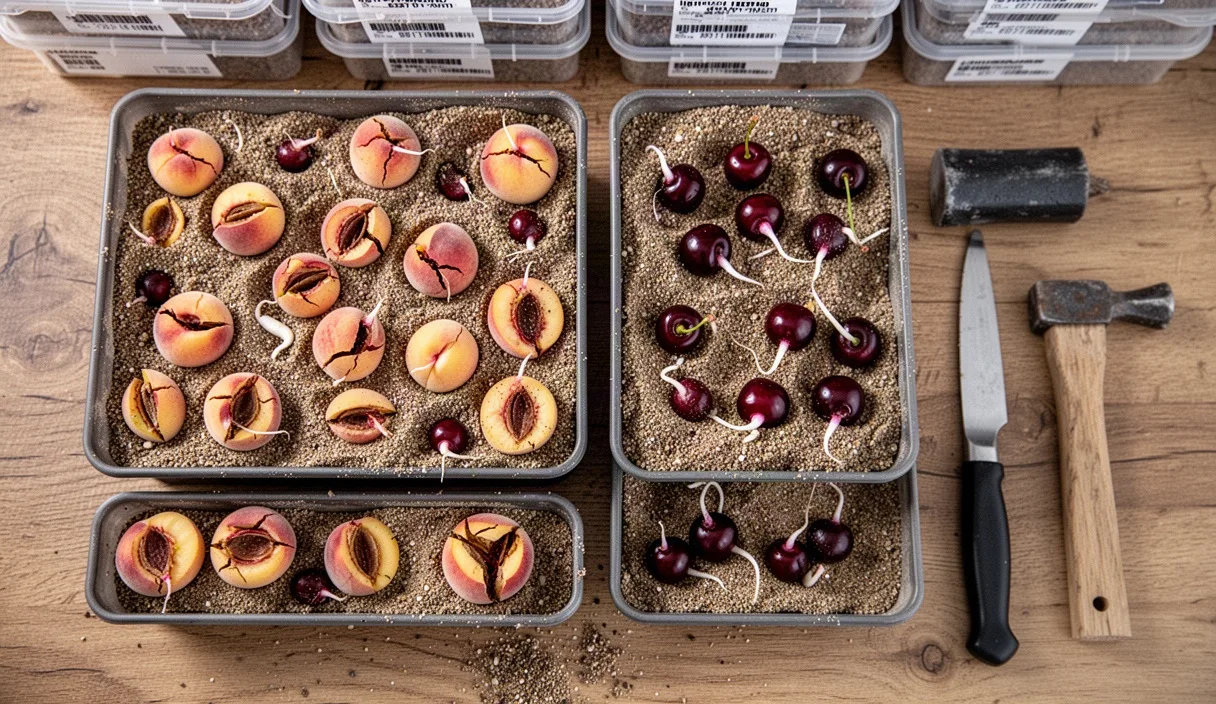
Break seed dormancy by tracking sustained thermal exposure between 1.5 and 4.5 degrees Celsius. Stone fruit propagation requires systematic cold stratification to neutralize abscisic acid within the embryo and stimulate endogenous gibberellin synthesis. Without this physiological shift, seeds from the genus Prunus remain dormant inside the lignified endocarp, resulting in erratic emergence rates below 18 percent in open nursery beds.
Every commercial orchardist and nursery propagator must standardize their stratification runs based on verified chilling accumulation, controlled substrate moisture, and aggressive fungal suppression. This protocol details temperature parameters, medium physics, biological monitoring cycles, and handling requirements for germinating peaches, plums, cherries, and apricots under controlled storage conditions.
Chill hour baselines by stone fruit category
Chill accumulation only occurs when imbibed pits sit within a specific temperature band. The target range is 1.5 to 4.0 degrees Celsius. Temperatures above 6.0 degrees Celsius risk aborting the stratification sequence and triggering physiological anomalies, while temperatures below 0.5 degrees Celsius halt the biochemical cascade entirely by freezing moisture inside the endocarp pores.
Different Prunus species feature distinct genetic baselines for chill hour requirements. Sweet cherries require the longest chill duration, while low-chill peach cultivars bred for sub-tropical climates sit at the lower end of the schedule. Pits must undergo a 24-hour submerged water soak prior to clocking chill hours, as dry embryos cannot metabolize storage proteins or clear growth inhibitors.
| Stone Fruit Category | Botanical Designation | Required Chill Duration (Hours) | Equated Days in Cold Storage | Moisture Baseline by Weight |
|---|---|---|---|---|
| Sweet Cherry | Prunus avium | 1,350 to 1,600 | 56 to 67 days | 32 percent |
| Tart Cherry | Prunus cerasus | 1,200 to 1,450 | 50 to 60 days | 30 percent |
| European Plum | Prunus domestica | 1,100 to 1,350 | 46 to 56 days | 28 percent |
| Standard Peach | Prunus persica | 950 to 1,250 | 40 to 52 days | 26 percent |
| Japanese Plum | Prunus salicina | 750 to 950 | 31 to 40 days | 27 percent |
| Apricot | Prunus armeniaca | 600 to 850 | 25 to 35 days | 24 percent |
Check the origin of wild or open-pollinated seed lots before entering them into the cold schedule. A peach lot sourced from Northern domestic rootstock may demand 1,200 hours, whereas the same species collected from an unstabilized southern landrace might initiate root push after 680 hours. Maintain constant data logging with calibrated thermistors to verify that cold units do not drift due to room cycling or coil defrost actions.
Substrate selection: coarse sand versus horticultural perlite
The stratification medium serves two opposing mechanical functions: it must retain thin water films on the pitted endocarp walls without cutting off gas diffusion to the interior cotyledons. Dense soils collapse under sustained cold storage, suffocating embryos. Coarse builder sand and grade 3 horticultural perlite stand as the two defensible media for production runs.
Coarse sand features a high bulk density near 1.6 kilograms per liter. Its high thermal mass stabilizes internal batch temperatures against compressor cycling in cold storage units. Sand particles ranging from 1.2 to 2.5 millimeters in diameter leave sufficient macropore volume to prevent anaerobic standing water. The weight of sand keeps the pits firmly immobilized, preventing crooked radical growth during the early breach of the suture. However, sand clings tightly to wet endocarps, obscuring fine fractures during weekly visual checks.
Horticultural perlite has a bulk density of approximately 0.11 kilograms per liter. Its porous, closed-cell volcanic structure holds 3.5 times its dry weight in water while sustaining a gas pore volume above 42 percent. Perlite sheds cleanly from the pits during extraction, reducing mechanical tear rates on delicate radical tips. The primary operational risk is perlite float during moisture adjustments, which separates seed density layers and creates uneven stratification planes.
For large production batches exceeding 5,000 pits, a composite matrix works best: blend 60 percent coarse washed silica sand with 40 percent pre-dampened horticultural perlite by volume. Add water until a handful of the mixed substrate holds its structural integrity when compressed in the palm, yielding no free water drips between the knuckles. This delivers a consistent moisture tension near -10 kPa, ideal for long-term stone fruit dormancy break.
Fungicide drenches versus clean mechanical aeration
Sustained darkness and high humidity at 3.0 degrees Celsius foster cold-tolerant fungal pathogens, predominantly Botrytis cinerea, Penicillium expansum, and Trichoderma species. Mold blooms will enter the endocarp suture line and destroy the lipid-rich cotyledons long before the embryo can emerge. Propagators use either chemical fungicide drenches or cultural aeration strategies to suppress these outbreaks.
Chemical drenches rely on broad-spectrum protectant active ingredients. Commercial nurseries often deploy captan or fludioxonil suspensions as a pre-soak barrier. Following the 24-hour hydration soak, pits submerge for 10 minutes in a solution calibrated to 1.2 grams of active captan per liter of water. The pits are drained completely before blending into the moist substrate. This method provides residual fungal suppression for up to 90 days. Always verify local pesticide registrations and consult regional agricultural extension agents before applying chemical fungicides to propagating stock.
Clean mechanical aeration circumvents synthetic chemicals through physical hygiene and oxygen flow. This approach requires precise protocol adherence:
- Sanitize all seeds in a 0.5 percent sodium hypochlorite bath for 8 minutes, followed by a double flush with potable water.
- Pack the substrate-seed mix into high-density polyethylene containers drilled with 4.5-millimeter ventilation holes spaced every 80 millimeters across the side walls and lids.
- Cover container vent holes on the inside with surgical-grade microporous tape to allow continuous oxygen and carbon dioxide exchange while blocking airborne fungal spores.
- Install an inline radial circulation fan in the storage room running at low velocity to prevent micro-pockets of stagnant, saturated air around the bin surfaces.
Mechanical aeration demands cleaner starting materials than chemical treatments. If a seed lot arrives with persistent fruit pulp adhering to the pits, mechanical aeration will fail. Residual sugars accelerate Penicillium colonization within 21 days of storage, overwhelming passive ventilation and rotting the interior tissue.
Monitoring radical emergence inside dark cold rooms
Keep stratification containers in total darkness to replicate subterranean winter conditions and inhibit early shoot development. The emergence monitoring sequence must run on an inflexible calendar to prevent unmonitored germination beneath the medium surface.
Run inspections on a 14-day interval throughout the first 60 percent of the target chilling duration. Pull three random sample points from each container, digging down to the bottom third of the box where moisture accumulates. Inspect the endocarp sutures with a handheld 10x hand lens. Pits swell as hydration peaks: watch for the suture line parting by 0.5 to 1.0 millimeter, revealing the white inner integument.
Accelerate inspections to a 4-day interval once the seed lot passes 70 percent of its target chill hours. At this stage, cold-tolerant enzymes initiate rapid radical elongation. Conduct these high-frequency inspections under narrow-spectrum green light (510 to 530 nanometers) or dim, indirect work lighting. Avoid high-output white light or direct sun, which warms the upper layer of the media and promotes uneven, leggy root initiation while the rest of the flat lags behind.
If early radical split occurs before the intended planting window, immediately lower the room temperature setpoint to 0.5 degrees Celsius. This drop does not freeze the seed tissue, but it stops metabolic elongation in stone fruits, buying the production crew up to 12 days of holding time while finishing field or greenhouse preparations.
Direct transplant timing when the radical reaches 5 millimeters
Extract seeds from the stratification medium the moment the white radical tip measures between 4.0 and 6.0 millimeters beyond the outer margin of the fractured endocarp. A 5-millimeter radical indicates that the vascular cylinder is intact, the root cap has formed, and the seedling retains sufficient internal energy reserves to push through field soils.
Allowing the radical to grow past 8.0 millimeters creates major operational liabilities. Extended radicals develop high turgor pressure and turn brittle, snapping under minimal sorting pressure. Lateral root primordia also begin organizing behind the root apex once length exceeds 10.0 millimeters. Damaging an extended radical at this stage aborts apical dominance, triggering malformed, branched root structures that permanently degrade tree anchorage in the orchard.
Handling procedure during the transplant window
- Sift the stratification matrix through an 8.0-millimeter hardware cloth screen to gently separate loose substrate from the emerging pits. Avoid shaking the screen aggressively.
- Sort the pits manually using vinyl-gloved hands or smooth plastic tweezers. Discard any specimens displaying brown, water-soaked, or hollow radical tips.
- Keep extracted seeds submerged in a cool tray lined with water-saturated unbleached paper towels. Never let the exposed white root tissue dry in open air for more than 90 seconds.
- Place each pit into deep tree pots or prepared nursery beds at a depth of 25 to 30 millimeters. Orient the split endocarp so the radical faces downward or laterally at a 45-degree angle to prevent upward looping.
- Backfill with a weed-free potting mix or sandy loam soil warmed to 16.0 to 18.5 degrees Celsius. This temperature differential stops stratification pathways and switches the plant into active root growth.
Drench the newly transplanted flats immediately with clean water to settle the media around the hypocotyl zone and eliminate structural air pockets. Maintain greenhouse temperatures at 20.0 degrees Celsius during the day and 14.0 degrees Celsius at night to encourage rapid cotyledon emergence through the soil surface.
Common mistakes
Propagators regularly compromise cold stratification runs through simple environmental oversights. Correcting these specific errors protects seed batch viability:
- Relying on kitchen-grade refrigerators: Residential cold units generate severe internal thermal gradients. Temperatures regularly swing from minus 1.0 degree Celsius near the rear cooling element to 8.0 degrees Celsius inside door trays. Use only commercial cooling cabinets equipped with dual-stage digital temperature controllers.
- Stratifying completely uncleaned pits: Leaving dried fruit residue on the stone guarantees fungal outbreaks. Scour the endocarp surfaces mechanically with stiff nylon brushes, wash thoroughly, and air-dry for 4 hours before entering the stratification medium.
- Saturating the medium to waterlogged levels: Stone fruit embryos demand high levels of dissolved oxygen. If the substrate drips water without being squeezed, pore spaces are full, and the embryos will asphyxiate within 18 days.
- Prematurely planting ungerminated pits into hot soil: Moving stratified seeds directly into field beds warmer than 24.0 degrees Celsius triggers secondary dormancy (thermodormancy). Once this state locks in, seeds require a second, full winter cycle to break dormancy.
Immediate actions for nursery operators
Check all storage thermistors against an ice-point calibration bath (0.0 degrees Celsius) prior to loading any plant material into the cold room. Replace any sensor reading beyond 0.4 degrees of divergence. Audit physical seed lots on hand: verify that endocarps show no signs of persistent surface pulp or sour fermentation odors. Mix sand and perlite substrates 48 hours ahead of processing, allowing moisture to equilibrate evenly through the mass before burying the seeds. Program strict inspection reminders into the facility schedule based on the species-specific chill durations mapped above, and secure your growing containers and seedling media before chill completion hits 80 percent.