 Arboris Botanical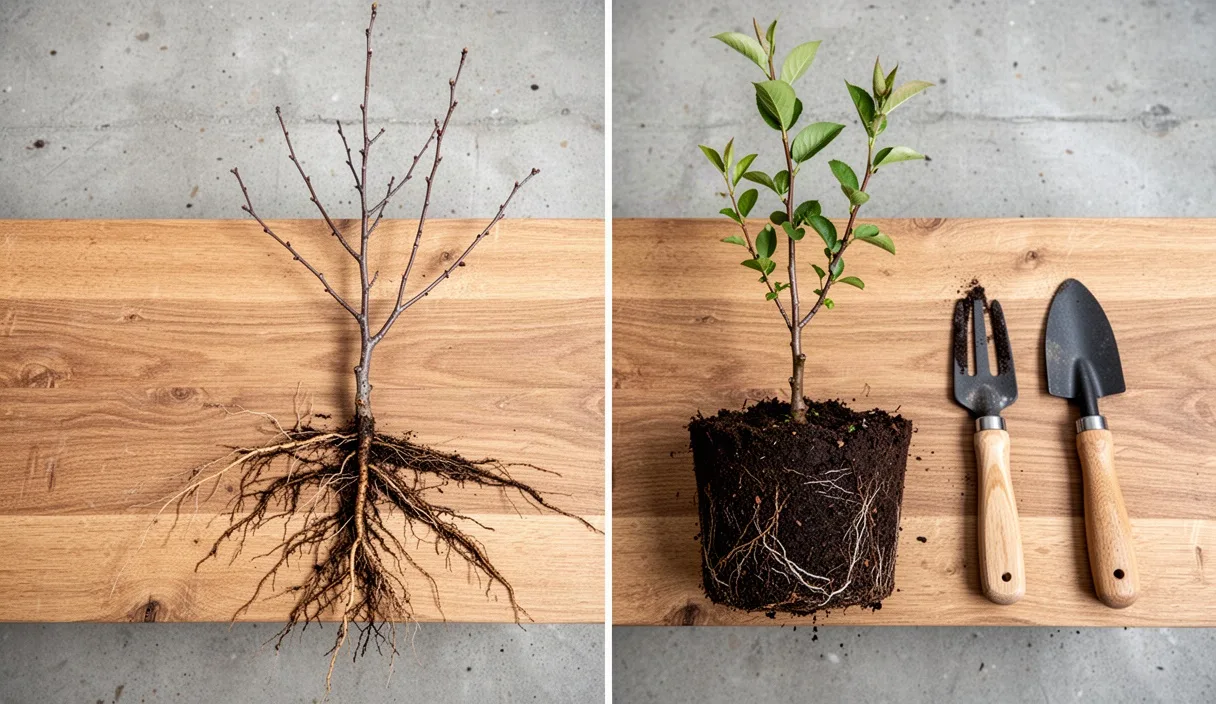
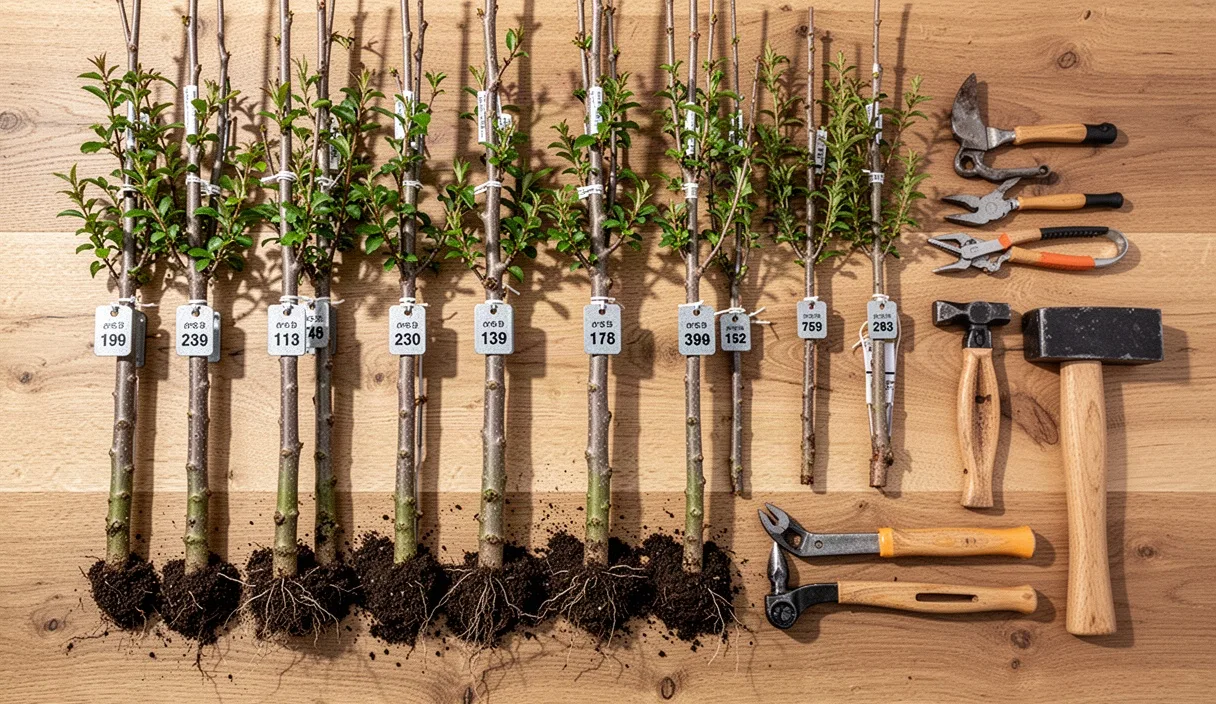
Stock selection determines multi-year survival before planting begins. Commercial growers, orchardists, and re-vegetation managers face a persistent operational choice: purchase field-dug bare root stock dormant in winter, or invest in year-round container-grown units. While container stock offers planting flexibility across an extended calendar window, the legacy of root restriction introduces mechanical and physiological vulnerabilities that can persist for decades. Bare root stock carries strict handling limits and a narrow dormant installation window, yet provides natural root geometry and drastically reduced freight mass.
Our five-year comparative trial measured physiological performance across 4,200 individual woody plants across two disparate planting sites: a heavy clay loam river bottom and a well-drained gravelly upland bench. By tracking establishment milestones, water usage, labor inputs, and mortality across three representative species, we isolated the financial and biological tradeoffs of each production method. The following performance metrics eliminate guesswork for acreage installations.
Comparative survival rates from our 5-year nursery field trial
Field data collected between 2019 and 2024 revealed significant establishment differences between bare root and #2 (6.0-liter) container stock. The trial monitored three standard commercial species: Northern red oak (Quercus rubra), Italian prune plum (Prunus domestica), and Douglas fir (Pseudotsuga menziesii). All units were planted during optimal dormancy windows: late February for bare root, and mid-March for containerized stock. Soils were neither fumigated nor supplemented with amendments, replicating commercial production practices.
During the first growing season, containerized stock showed an initial survival edge, driven by an intact potting substrate buffer. By Year 3, however, structural root defects in containerized plants began yielding failures, particularly under high-wind events and drought stress. By Year 5, bare root stock equaled or outperformed container stock across all deciduous metrics. Coniferous stock showed closer parity, though bare root stock displayed superior anchoring against wind-throw in high-exposure trial plots.
| Species and Stock Type | Initial Planting Count | Year 1 Survival Rate | Year 3 Survival Rate | Year 5 Survival Rate |
|---|---|---|---|---|
| Quercus rubra (Bare Root 1-0) | 700 | 88.4% | 86.1% | 84.7% |
| Quercus rubra (#2 Container) | 700 | 93.2% | 84.6% | 77.3% |
| Prunus domestica (Bare Root Whips) | 700 | 91.7% | 89.3% | 88.1% |
| Prunus domestica (#2 Container) | 700 | 94.6% | 87.4% | 82.6% |
| Pseudotsuga menziesii (Bare Root 2-0) | 700 | 81.3% | 78.9% | 76.4% |
| Pseudotsuga menziesii (#2 Container) | 700 | 86.7% | 80.1% | 78.2% |
The high late-stage mortality of containerized Quercus rubra (dropping from 93.2% to 77.3%) resulted directly from uncorrected root-circling defects that choked secondary vascular expansion as stem calipers exceeded 38 millimeters. When root collars were excavated in Year 5, 41.6% of surviving containerized oaks exhibited girdling or J-hook root conformations that compromised vertical anchorage.
Root biomass architecture: taproot integrity versus container circling
Root system architecture dictates wind resistance, nutrient uptake efficiency, and drought tolerance. In bare root production, seedlings and field-grown liners grow in open ground, developing uninhibited radial lateral roots and, in deep-rooted species, vertical taproots. When dug mechanically with a U-blade during winter dormancy, approximately 60% to 75% of the fine feeder roots remain in the nursery bed. However, the foundational structural framework remains unaltered: primary laterals originate from the trunk radially without directional deflection.
Container cultivation forces root tips to encounter non-yielding plastic walls. Upon reaching the container perimeter, roots divert downward and circle the base. This behavioral shift creates three structural failures:
- Girdling Root Formations: Roots encircle the main stem collar. As both the stem and the circling root expand in radial caliper, the root constricts vascular transport in the phloem and cambium.
- Substrate Interface Barrier: The abrupt textural boundary between soilless peat-perlite nursery mixes and native mineral soil prevents capillary continuity, discouraging roots from penetrating the native planting wall.
- Absence of Deep Anchorage: The loss of a functional downward taproot forces the plant to rely entirely on shallow adventitious laterals, reducing tolerance to extreme thermal swings in surface soil layers.
Mechanical root washing in Year 4 of our trial demonstrated that bare root oaks developed a lateral spread 2.3 times wider than containerized counterparts. Containerized oaks maintained 68% of their root mass within a 45-centimeter cylinder directly below the trunk, mirroring their original plastic nursery vessel. This lack of lateral expansion leaves trees vulnerable to soil-shearing failure under wet winter windstorms.
Labor hours required per hectare: bare root trenching versus auger holes
Field deployment speeds vary dramatically between stock systems. Bare root planting operations move rapidly because crew members transport minimal weight and excavate narrow trenches or slit pits. Container planting mandates large-diameter hole excavation, container removal, root slicing, backfill consolidation, and container disposal management.
To determine accurate labor requirements, we logged work hours across two 10-hectare trial plots using a planting density of 1,200 stems per hectare. Soil conditions were uniform clay loam with minimal surface rock.
Bare root continuous-line trenching protocol
Bare root operations utilized a single 65-horsepower utility tractor equipped with a subsoil trenching blade, operated by one tractor driver and two trailing planters setting trees directly into the continuous slice, followed by a packing wheel. A support team of two workers hauled stock in water-misted bundles and pruned broken roots prior to placement.
- Tractor and trenching pass: 3.4 tractor hours per hectare.
- Direct planting labor (5-person crew): 16.5 worker hours per hectare.
- Staging, root dipping, and field distribution: 4.2 worker hours per hectare.
- Total labor input: 24.1 person-hours per hectare.
Containerized auger planting protocol
Container installation required a skid-steer loader equipped with a 350-millimeter hydraulic auger, one operator, a staging team hauling heavy root balls, three planters manually root-pruning (box-cutting circling roots on four sides) and setting trees, and two workers backfilling, tamping, and collecting plastic containers for recycling.
- Skid-steer auger excavation: 8.8 machine hours per hectare.
- Hand preparation and box-cutting roots: 14.6 worker hours per hectare.
- Placement, backfill, and mechanical tamping: 26.3 worker hours per hectare.
- Casing logistics, container collection, and staging: 11.4 worker hours per hectare.
- Total labor input: 61.1 person-hours per hectare.
Labor savings for bare root installation totaled 37.0 person-hours per hectare, a 60.5% labor reduction. In steep terrain where machinery cannot operate, hand crews planting with Swedish planting bars (pottiputki or planting hoes) widen this margin further, reaching production rates of 110 bare root plants per worker per hour, compared to 28 container plants per worker per hour using manual spades.
First-season water demands under each root system format
Hydration dynamics during the initial 180 days post-budbreak dictate survival. A pervasive misconception suggests that containerized plants require less water due to their intact root balls. Field observations show the reverse: container media exhibits an aggressive wicking effect that accelerates desiccation when surrounding field soils dry out.
Commercial container media consists predominantly of pine bark, peat moss, and perlite. This mixture creates an open pore structure with matric potential vastly different from surrounding native silt or clay. When native soil moisture drops below field capacity, the high hydraulic conductivity of native mineral soil pulls moisture outward from the porous container core. Unless water is applied directly to the original root-ball cylinder, the plant experiences acute drought stress, even when surrounding native soil appears moist.
| Establishment Variable | Bare Root Stock (Field Soil Dig) | #2 Container Stock (Bark/Peat Media) |
|---|---|---|
| Hydraulic connection to native soil | Immediate (direct mineral contact) | Delayed (interrupted by potting media boundary) |
| Target irrigation zone | Radial area 45 cm around trunk | Directly onto top of original container plug |
| Peak summer application rate | 16 liters per plant every 10 days | 12 liters per plant every 4 days |
| Seasonal irrigation volume (Year 1) | 256 liters per tree | 432 liters per tree |
| Wilt threshold under heat event (38°C) | Day 12 post-irrigation | Day 5 post-irrigation |
Bare root plants re-establish intimate soil contact within 14 days of spring root flushes. New root hairs form directly in native field pores, utilizing residual subsoil moisture reserves. Irrigation regimes for bare root systems can utilize deep, infrequent watering cycles, driving root development downward. Container stock requires short-interval, frequent pulses to prevent the peat plug from drying into a hydrophobic block. Once a peat plug desiccates completely, re-wetting requires slow-drip saturation; standard overhead irrigation simply channels water around the shrunken plug through edge gaps directly into the subsoil, bypassing root tissue entirely.
Cost-per-acre breakdown including transport freight weight
Nursery procurement budgets often overlook logistics costs. Shipping containerized plants involves transporting tons of damp potting medium and water, whereas bare root shipping transports only dormant plant tissue and moist packing material. This physical reality reshapes project economics at scale.
Consider a standard commercial spacing model: 480 trees per acre (roughly 1,186 trees per hectare) on an orchard or high-density conservation planting model. Sourcing 2,400 trees (covering 5 acres) provides a baseline for comparing standard long-haul transport across a 500-kilometer freight run.
| Expense Category | Bare Root Format (4-6 ft Whips) | #2 Container Format (2-Gal Pots) |
|---|---|---|
| Wholesale nursery unit cost | $8.45 per unit ($20,280 total) | $16.20 per unit ($38,880 total) |
| Stock weight per 1,000 units | 160 kg (dormant, tied bundles) | 4,200 kg (saturated container media) |
| Total shipment weight (2,400 units) | 384 kg | 10,080 kg |
| Freight transport required | Single flatbed box space / parcel racks | Dedicated 53-foot drop-deck trailer |
| Freight and offloading cost | $620 total shipping | $3,450 total shipping |
| Planting labor cost ($26/hr) | $1,253 ($250.60 per acre) | $3,177 ($635.40 per acre) |
| Container disposal / recycle fees | $0 | $280 processing fee |
| Total establishment cost (5 acres) | $22,153 | $45,787 |
| Final cost per acre | $4,430.60 | $9,157.40 |
The per-acre expenditure for container installations is more than double that of bare root installations: $9,157.40 per acre compared to $4,430.60 per acre. Freight weight is the main logistical driver. A standard utility trailer or single axle truck can move enough bare root stock to plant 20 acres in a single trip. Moving container stock for the same acreage requires multiple heavy commercial transport runs, specialized off-loading machinery at the staging point, and internal distribution transport capable of hauling heavy pallet loads across wet spring fields without causing site-destructive soil compaction.
Common mistakes
Root desiccation during staging causes most bare root project failures. Root systems exposed to direct sunlight and wind for as little as fifteen minutes suffer fine feeder root death. Staging crews must keep root bundles completely enclosed in damp wood shavings, shredded cardboard, or immersion tanks until the precise moment the plant enters the planting furrow.
For container stock, the most persistent installation error is planting directly into smooth augered holes without scarring the excavation sidewalls. Hydraulic augers operating in clay soils polish the hole circumference, creating a glazed, vitrified surface that root tips cannot penetrate. If mechanical augers are used, hand crews must score the hole perimeter with a planting pick to break the glazed face before setting stock.
Deep planting causes fatal consequences in both systems. Settling soil often pulls the root flare deep below grade. If the root flare is buried under more than 25 millimeters of mineral soil, latent bark tissues suffocate, adventitious non-structural roots emerge above the scaffold root system, and collar rots take hold. The root flare must remain at or slightly above natural grade after initial irrigation settling.
Next steps for site managers
Field implementation demands a structured operational sequence. Execute the following actions to prepare for the planting window:
- Conduct a soil structural assessment: Sample field plots at 20-centimeter and 45-centimeter depths. If compaction layers exceed 2.1 megapascals of resistance on a penetrometer, plan a subsoiling or ripping pass along prospective planting rows at least 60 days before installation.
- Audit wholesale contracts for root handling standards: When ordering bare root stock, require your nursery supplier to specify dig dates and cold-storage humidity levels (minimum 92% relative humidity at 1.5°C to 3.0°C). For container stock, demand assurances that plants have been container-stepped within the preceding six months to prevent dense inner root balls. Consult a certified consulting arborist or professional nurseryman if lot specifications show discrepancies.
- Establish on-site hydration facilities: Construct a shaded staging bay equipped with potable water, non-toxic water-retaining hydrogels or shredded damp straw, and temporary windbreaks before any stock arrives on site. Ensure nursery delivery schedules match planting capacity so stock remains staged for no more than 72 hours prior to planting.
- Calibrate equipment to match stock geometry: Set tractor-mounted trenching blades or hand trenching spades to match the deepest root system in the incoming grade. Ensure that planting depths leave the basal root flare 20 millimeters above ground level to compensate for natural hydraulic settlement.